

Véronique Dupéré
In Quebec, secondary students in the latter years are more numerous (33%) than their younger peers to experience high levels of psychological distress or to have a diagnosed anxiety-depressive disorder (6.1%).
Although various studies have shown the effectiveness of programs aimed at mitigating these symptoms, few have assessed the impact of extracurricular activities on students' psychosocial adaptation. These activities provide a privileged context to mobilize the strengths of young people and their environment to promote adolescent flourishing.
A doctoral candidate at the School of Psychoeducation at the University of Montreal, Rocio Macabena Perez chose to conduct a mixed-methods research project with secondary students by involving them in an artistic after-school program called Art en tête.
For young people with socioemotional difficulties

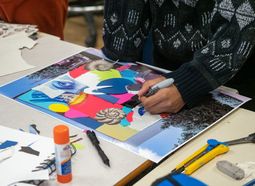
Offered since 2021 by the non-profit organization MU, Art en tête is an artistic mural art after-school program "dedicated to supporting and promoting the psychosocial and academic adaptation of secondary students facing socioemotional difficulties, such as anxiety, depressive moods, or social difficulties," states Rocio Macabena Perez, who is also the initiator and coordinator of the program.
Developed based on targeted needs on the ground, it is the result of innovative and long-term collaboration among community, hospital, school, and university environments.
As part of her research project, the doctoral student followed 50 young people from four Quebec high schools. To compare the effect of the program, two groups of students initially participated, while the other two were placed on hold and served as control groups. These latter groups participated in the program the following year.
Data collection in two phases
The students – aged 15.6 years on average – were required to attend artistic creation workshops, then create a mural inside their school for two hours after class over 13 weeks.
The composition of each of the four groups was mixed: students facing difficulties made up about two-thirds of a group, while the other third consisted of young people with harmonious functioning. Each group was led by an artistic educator and professional artist from the MU organization and a psychosocial companion attached to the participating school whose role was to support the students' engagement in the program.
Throughout the project, Rocio Macabena Perez, supervised by her two research directors and professors at the School of Psychoeducation, Kim Archambault and Véronique Dupéré, collected quantitative data based on seven indicators of psychosocial adaptation*.
The quantitative data were obtained using questionnaires that students answered before starting the program, then two weeks after completing it, and a follow-up was conducted five months later.
Qualitative data from 18 interviews with the youths were also collected: they helped assess the scope of social relationships built within the Art en tête program between the youths themselves and with the adults involved.
Mural art for promoting well-being
Overall, the Art en tête program yielded positive results for each of the indicators, but "the major result is the significant reduction of symptoms associated with depression: with an effect size of 0.25 between the active and control groups, this after-school program of adapted artistic activities provides a positive effect similar to targeted interventions for depression," specifies Rocio Macabena Perez.
Moreover, exploring relational experiences "has allowed us to understand what happens in after-school programs in relation to the development of positive relationships between youths and with adults, an aspect of social relationships that is not always acquired among young people with socioemotional difficulties," she adds.
Five months after the end of the program, the positive effects were still measurable, notably in terms of positive self-esteem, a sense of self-efficacy, and social functioning, with a tendency to improve for all other indicators.
On a qualitative level, the 18 interviewed youths reported greatly appreciating the bonds they formed with their peers and adults, as well as the relational climate throughout the workshops. And the vast majority grew to feel a sense of collective achievement and belonging to the community.
"These results, published in the Journal of Psychoeducation, highlight the relevance and complementarity of positive development approaches in the continuum of mental health services for youths, notably in the form of artistic after-school activities," concludes Rocio Macabena Perez.
*The seven indicators were as follows: depressive mood, anxious manifestations, subjective well-being, positive self-esteem, negative self-esteem, a sense of self-efficacy, and social functioning.
This content has been updated on 30 avril 2024 at 16 h 50 min.
Comments